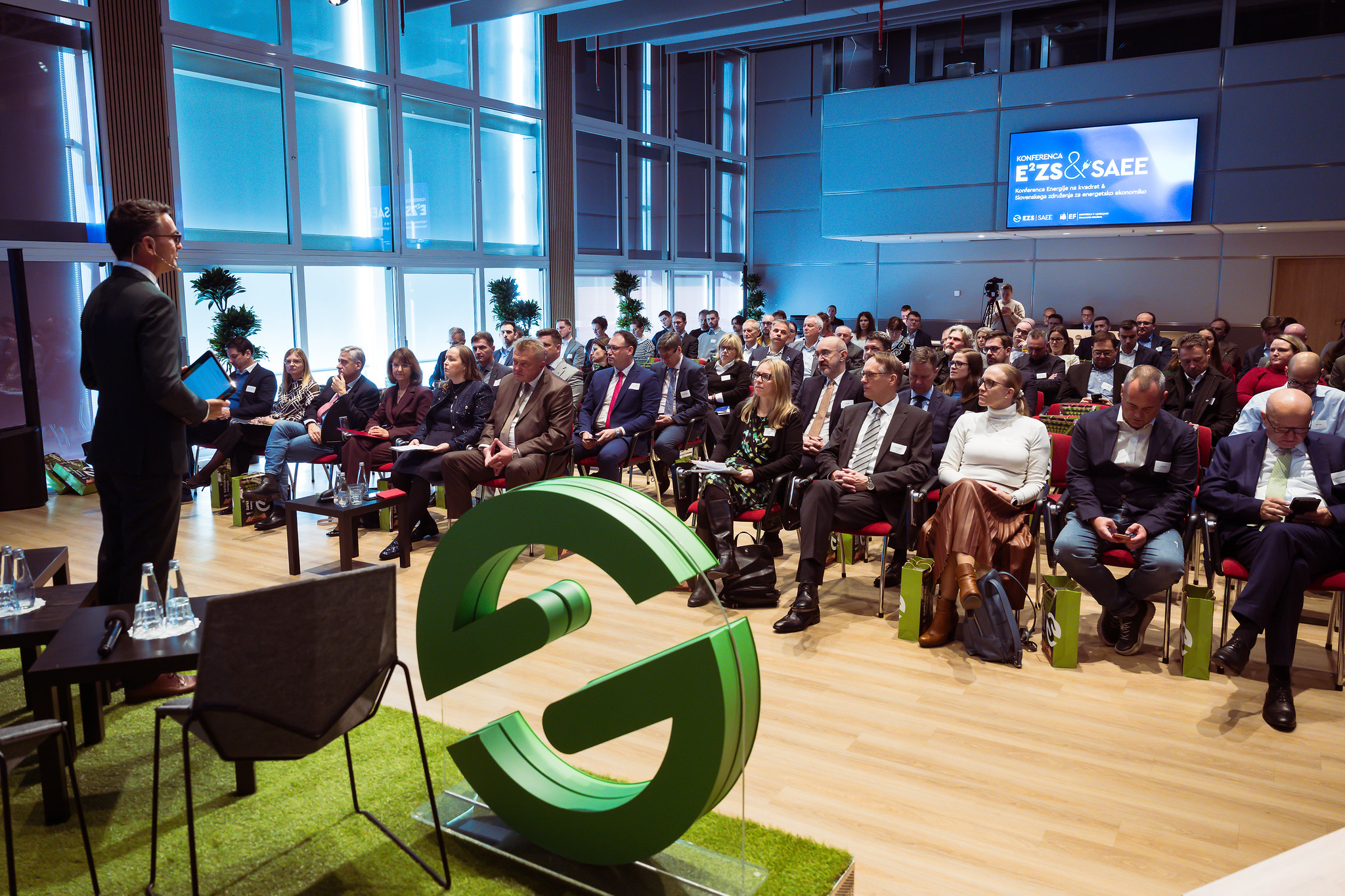
On Friday, November 20, 2026, the Energy Industry Chamber of Slovenia (EZS) and its Slovenian Association for Energy Economics (SAEE) section – in collaboration with the School of Economics and Business at the University of Ljubljana (UL EF) – hosted the E2ZS & SAEE conference, which focused primarily on the economics of the energy sector. The key message: In times of frequent energy shocks, affordable (electrical) energy can only be maintained by transforming the European market toward long-term planning, alongside stronger cross-border interconnection and coordination. In Slovenia, however, expanding and developing the electricity grid will require urgently addressing the challenge of underfunded network charges.
The European electricity market on the verge of transformation: from short-term trading to long-term stability
Dr. Aaron Praktiknjo, Professor at RWTH Aachen University and President of the International Association for Energy Economics (IAEE), highlighted the growing tension between recurring short-term crises and rapid changes on one hand, and long-term investment decisions on the other. He noted that energy infrastructure and the fundamental transformation of energy systems require highly capital-intensive investments that must be made today—despite enormous uncertainty surrounding future markets, technologies, and policies, as well as tight public finances.
“If we were to apply only classic economic theory to the analysis of energy, there are many things we would not understand. That is why it is truly important to include society and policymakers in our discussions as well. This is exactly what we strive for at IAEE, and I am very pleased to see that you are actively building these connections in Slovenia too,” emphasized Dr. Praktiknjo.
Watch the energy dialogue with Prof. Praktiknja HERE.
Dr. Fulvio Fontini, professor at University of Salento and a member of Italian Association of Energy Economics (Associazione Italiana Economisti dell’Energia – AIEE), highlighted the evolution of the European market design. The European electricity market is shifting from its traditional focus on short-term trading toward long-term planning to shield consumers from price volatility, coordinate grid expansion, and balance security of supply with the green transition and affordability. Because piecemeal fixes are no longer enough, the future market design embraces a holistic approach that promotes competition “for” the market rather than merely “in” the market—relying on long-term contracts (PPA), contracts for difference (CfD), modernized capacity mechanisms, and greater participation of active consumers and flexibility providers. At the same time, critical strategic questions remain open for the future: how much room is left for market-based pricing of electricity as a commodity and decentralized solutions, how effectively market power can be controlled, and how truly “European” Europe’s energy companies really are.
His PowerPoint presentation is available HERE.
Daniel Ihasz-Toth, Team Leader of Security of Supply Team, ACER, emphasized that building a pan-European energy market is a multi-stage journey in which deeper integration and rising system complexity demand stronger cross-border coordination, as uncoordinated policies risk putting decarbonisation at odds with competitiveness and economic growth. “If Europe wants to succeed in its green transition while keeping its economy competitive, countries must work closely together on energy policy. Connecting European power grids already delivers €32 billion per year in savings and benefits, and it plays an important role in preventing power shortages – when one country faces a temporary drop in electricity production, neighbouring countries can quickly step in to help. European oversight and transparency rules also ensure that this shared market remains fair and trustworthy,” said Ihasz-Toth.
Building a united European Energy Union will require making cross-border decisions more coherently. European countries are spending increasing amounts of money to guarantee a reliable power supply, and these national investments often benefit neighbouring countries as well. “That is why network expansion, supply security, and climate goals should be planned together across Europe – realising synergies and unlocking competition among the best solutions keeping electricity affordable for everyone,” Ihasz-Toth concluded.
His PowerPoint presentation is available HERE.
Excessively low network tariffs in Slovenia prevent power grid development; public perception of “high” tariffs is misguided!
During the conference session dedicated to energy affordability for consumers, Aleksander Mervar, MSc, CEO of ELES and President of Energy Industry Chamber of Slovenia, warned that network tariffs in Slovenia are very low and will not allow for the expansion and development of the power grid in the future. “In 2025, both Slovenian household and non-household consumers paid some of the lowest network tariffs in the EU. Considering the small size of the Republic of Slovenia’s power system, this is actually surprising, as the general rule is that the smaller the power system, the more expensive it is. What is even more surprising is the fact that the transmission grid of the Republic of Slovenia is considered one of the three best-developed transmission grids in the EU,” Mervar emphasized.
|
Mervar noted that the perception among the majority of the public – that network charges are high and have increased further following the October 2024 reform – is incorrect.
In fact, network tariff revenues in 2025 were more than 13% lower (EUR 47.5 million lower) than in 2023 (the last full year prior to the implementation of the network tariff reform in October 2024). “Meanwhile, the required investments in the distribution and transmission grids are substantial; at the distribution level, they can be up to 100% higher than the capital investments made between 2016 and 2023. One would therefore expect annual network tariff revenues to increase. However, the exact opposite is happening. Network tariffs in our country have lagged behind inflation and actual needs for many years,” Mervar stated clearly.
According to his assessment, network tariffs for the use of the distribution grid would need to increase by 37% today for the operator to cover the regulatory framework set by the Energy Agency.
Only 61% of the regulatory framework determined by the Energy Agency is covered by the network tariffs collected in Slovenia, while the remaining 39% shortfall is covered by ELES through revenues generated from the allocation of cross-border transmission capacities. “However, these exact revenues will begin to decline in the coming years due to structural changes in the European electricity market. Consequently, there are no secured financial resources to carry out the investments outlined in the 2025–2034 Distribution System Development Plan. We face a real concern that without an increase in distribution network tariffs, ELES’s indebtedness will become unsustainable,” the ELES CEO warned, adding that a significant increase in distribution network tariffs is therefore essential. Nevertheless, he estimates that 2027 will not be an appropriate year to raise electricity network tariffs, as we are simultaneously facing an exceptional surge in wholesale electricity prices for both the remainder of this year and the entirety of 2027.
The CEO of ELES also presented various energy balance scenarios up to 2044; under all scenarios, Slovenia’s import dependency will increase during this period. He also presented the findings of his study on the long-term development of the Slovenian power sector, including their financial valuation. The study is available on the ELES website here.
His PowerPoint presentation is available HERE.
The event fostered an open, candid, and constructive dialogue, bringing together energy experts, academic and research institutions, and government officials from the Ministries of Foreign Affairs and Energy, alongside representatives from the European Commission and the Agency for the Cooperation of Energy Regulators (ACER).
The conference comes at a critical juncture, as global energy markets face their third major disruption in just six years. Following the COVID-19 pandemic, the sector was shaken by geopolitical turmoil triggered by the Russian-Ukrainian war, and most recently by the Iran-Israel conflict and the protracted crisis in the Middle East. Navigating these complex challenges requires solutions grounded in scientific research—particularly as the sector strives to stay on course with its clean energy and green transition commitments.
*****
The moderators of the conference were:
- Nevenka Hrovatin, PhD, School of Economics and Business, University of Ljubljana; Vice-President of the Slovenian Association for Energy Economics (SAEE); President-Elect of the International Association for Energy Economics (IAEE) for 2027 and President of the IAEE for 2028
- Karina Medved Bregar, Head of EU affairs and projects at Petrol; Vice-President of the Eurelectric Section
- Jelena Zorić, PhD, School of Economics and Business, University of Ljubljana; member of the E2ZS&SAEE conference programme committee
- Ana Vučina Vršnak, MSc, Executive Director of the Slovenian Energy Industry Chamber of Slovenia (EZS) and Chair of the E2ZS&SAEE conference organizing committee.
*****
The 216-page Proceedings of the E²ZS & SAEE Conference (Energy Squared & the Slovenian Association for Energy Economics) are now live, bringing together all 31 peer-reviewed research papers: https://ezs.si/publikacije/EZS_SAEE_zbornik.pdf
***
The Energy Chamber of Slovenia (EZS) extends its sincere gratitude to all international and local speakers for contributing to an outstanding conference program.
Thank you to all attendees for bringing such great energy to the event, as well as to our sponsors and partners for their support: